
Indigenous Flight Avionics Suite
Uddan
Fixed-wing VTOL survey aircraft. Uddan means “flight”.
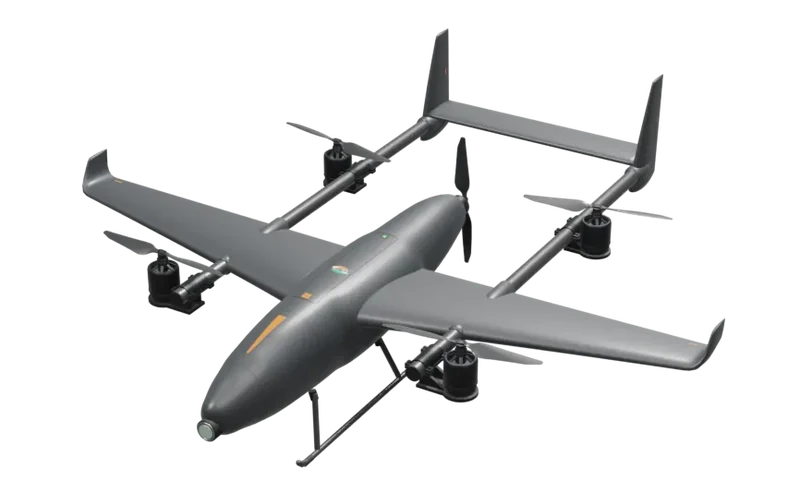
A twin-boom survey aircraft that takes off vertically, cruises on a pusher and maps from a belly camera.
Uddan is a twin-boom, high-wing survey aircraft that lifts off vertically on four fixed rotors, cruises on a single pusher and lands on the same patch of ground. It maps corridors and large areas from a nadir camera in one belly cassette, and needs no launcher, catcher or tilt mechanism.
Indicative specification
| Configuration | Twin-boom, high straight wing, 4 lift rotors + 1 pusher |
|---|---|
| Wingspan | 2.4 to 3.0 m class |
| Length | 1.2 to 1.5 m |
| Maximum take-off weight | 8 to 10 kg class (DGCA Small category) |
| Sensor payload | Up to 1 kg including mount and interface |
| Endurance | 60 to 90 min target |
| Cruise speed | 15 to 18 m/s |
| Coverage per flight | 300 to 500 ha at 120 m AGL (RGB), or a 40 to 60 km corridor |
| Wind tolerance | 10 to 12 m/s in cruise; 8 to 10 m/s in the VTOL phases |
| Launch and landing | Vertical, from a ~5 × 5 m flat clearing |
| Positioning | Multi-constellation GNSS with NavIC; PPK/RTK option, 2 to 5 cm class with PPK |
| Command and video link | 8 to 10 km line of sight, encrypted |
All figures are indicative targets, subject to aerodynamic and structural validation and to QCI/DGCA type certification under the Drone Rules 2021; coverage and accuracy depend on the camera, overlap and the PPK option.
Interfaces and compatibility
- Payload: a cassette bay with a keyed power and data connector, for a nadir RGB or multispectral camera.
- Ground: the Kendra ground station for planning, monitoring and PPK log download.
- Power: a single pack through the dorsal hatch, charged off the aircraft.